Ragdoll Break: Let's destroy!
- 4.3
- Rating
- 50.00M
- Installs
- Free
- Price

 Analysis by App-foxy
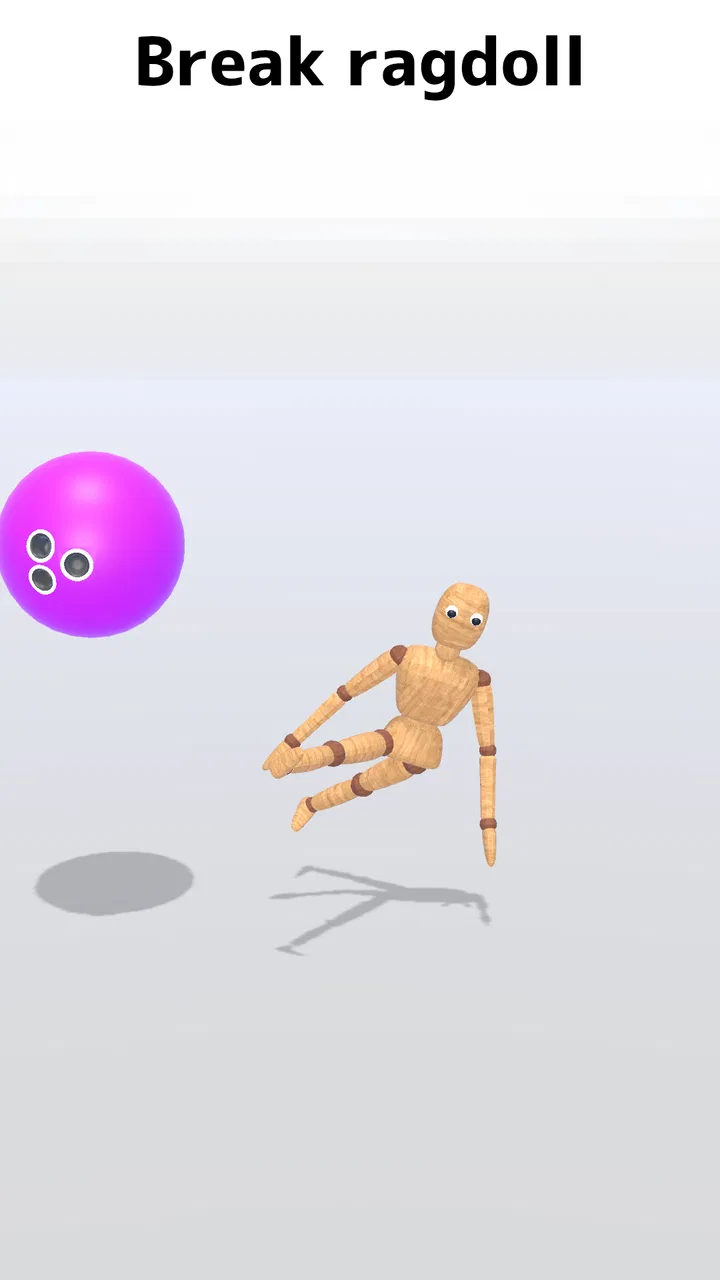
Ragdoll Break: Let's destroy! is an action game built around one very clear idea: take control of a ragdoll, put it through destructive situations, and enjoy the immediate visual response. I found it easy to understand within seconds, which is exactly why it works well when I want something casual rather than a game that asks me to learn a large map, memorize complicated controls, or follow a long story.
The first thing that stands out is how quickly the game gets to its main action. There is no need to spend a long time preparing a character or studying a tutorial. I can begin, experiment with movement, watch the ragdoll react, and decide whether I want to try the same situation again. That straightforward approach makes it a natural fit for short breaks, although it also means the experience depends heavily on whether I enjoy repetition and physical comedy.
How the destructive game loop feels in practice
I’ll look at how the game’s simple action holds up beyond the first few attempts, including the small choices that can make a short session feel more satisfying. That practical angle matters because the loop is easy to grasp, but its appeal depends on how you approach each retry.
You May Also Like

 Blood Strike: 2.5 Anniversary
Blood Strike’s Loadouts Turn Every Drop Into a Tactical Gamble
A close look at Blood Strike’s custom loadouts: how fast access to signature weapons reshapes its battle royale rhythm, rewards preparation, and narrows the gap between fights.

 Pandora - Music & Podcasts
Pandora’s Music Is Easy to Start, but Harder to Recover
Pandora’s strength is its low-effort path from a seed to a station. Its weak spot is how much confidence it asks you to place in connection, setup, and quiet recovery.

 8 Ball Pool
 Is Built on Rivalries, Rematches, and Routine
A close look at the rivalries, rematches, shared routines, and unanswered safety questions that turn a quick pool match into a persistent mobile community.

 Samsung Music
’s Quiet Strength Is Playing What You Already Own
Its reach comes less from spectacle than from dependable access to a personal library. That simplicity is both the app’s strongest retention engine and its ceiling.

 AccuWeather: Weather Radar
AccuWeather Review: A Quick, Clear Forecast for Everyday Decisions
For everyday plans, the best forecast is the one you can understand quickly. AccuWeather makes rain timing, radar, and local conditions easy to act on, with a few trade-offs.

 Hill Climb Racing
Why Hill Climb Racing Still Turns Crashes Into One More Run
A tiny car, a bumpy hill and one more upgrade: Hill Climb Racing keeps resurfacing because its simple chaos makes every near-miss feel personal.
More From Our News Desk



The first action is immediate and easy to understand
The appeal starts with the first interaction. Instead of asking me to manage several systems at once, the game focuses my attention on the ragdoll and the result of what I do with it. I do not need an elaborate explanation to understand the objective: create an entertaining collision, watch the body respond, and look for a satisfying outcome.
That simplicity is useful on a phone because touch controls can become frustrating when a game demands too much precision without a large screen. Here, the action feels more like playful experimentation than a serious test of reflexes. I can try a movement, see what happens, and adjust my next attempt. The low barrier to entry also makes it suitable for someone who normally avoids action games because they seem too demanding.
At the same time, the simple opening tells me what kind of game this is. It is not a replacement for a deep fighting game, a physics sandbox with extensive construction tools, or a conventional action adventure. The pleasure comes from the immediate ragdoll response, not from building a complex strategy over many hours.
Feedback gives every attempt its character
The feedback rhythm is the strongest part of the experience. I perform an action, the ragdoll reacts, and the game gives me a short moment to appreciate the result before I consider another attempt. That rhythm makes even a brief play session feel complete. I am not waiting through long menus to reach the interesting part.
What I like most is the separation between intention and outcome. I may begin with a simple idea, but the ragdoll’s movement can turn the result into something more amusing or more chaotic than expected. This is where the game’s physical comedy comes from. The action is not only about whether I succeeded; it is also about how the body moves, falls, or responds to the situation.
This feedback makes the game approachable for younger players as well as adults who want something mindless after work. It carries an Everyone content rating, and the presentation is framed as cartoon-like ragdoll destruction rather than realistic violence. Even so, the central theme is still breaking and smashing a character, so players who dislike slapstick destruction may not find the premise comfortable.
A useful way to play is to stop treating each attempt as a pass-or-fail challenge. I get more from it when I focus on changing one part of the action at a time. I might alter the direction, timing, or starting position, then compare the response with the previous try. That small habit turns random tapping into a light experiment and helps the loop remain interesting for longer.
The reward works because it arrives quickly
The reward in this game is closely tied to the action itself. Seeing the ragdoll react is already part of the payoff, and any progress or positive result gives me a reason to continue. The game does not need to bury the player under a complicated reward structure to make the next attempt attractive. The immediate visual response does much of the work.
This makes it especially effective in situations where I have only a few minutes. If I am waiting for an appointment or taking a short break between tasks, I can play without committing to a long mission. A single attempt has its own beginning and end, and I can put the phone down without feeling that I have abandoned a major objective.
There is also a small psychological trick in the loop: an unsatisfying attempt naturally creates curiosity about what would happen if I changed the approach. I may not be chasing a large narrative goal, but I still want to see whether the next action produces a better reaction. That is enough motivation for another round, particularly when the previous result was almost satisfying.
My advice is to use the reward as a prompt for controlled experimentation rather than endlessly repeating the same action. If a result feels predictable, change the setup instead of simply tapping faster. The game is at its best when I am watching for a different physical response, not when I am playing automatically.
Resetting keeps the game comfortable for short sessions
The reset is an important part of the design because it removes much of the pressure found in traditional action games. After an attempt, I can return to the action instead of carrying a complicated chain of consequences into the next round. That makes it easy to play casually and reduces the frustration that comes from losing progress after a mistake.
I found this especially convenient when I wanted a quick distraction but did not have the attention for a full level. The reset gives every attempt a clean starting point. I can try something reckless, observe the result, and begin again without worrying that one poor decision has damaged a long-term run.
The trade-off is that a clean reset can also reduce tension. Players who enjoy carefully protecting a character, managing limited resources, or making decisions with permanent consequences may find the experience too light. The game is designed around repeating the action, not around making every attempt feel precious.
For me, the best session length is short and intentional. I play until the reactions stop feeling surprising, then leave and return later. Because the game does not require a large time investment to be enjoyable, it suits this pattern well. Trying to force a long session can expose the limited depth of the central idea more quickly.
Why another session begins
The reason to start another session is not a complicated story question or a competitive ranking goal. It is the desire to see one more result. The loop of action, feedback, reward, and reset is compact enough that I can repeat it without preparation. That makes the game feel almost like a digital stress toy with a little more structure.
This also explains both its strength and its limitation. When I want a quick release from routine, the directness is refreshing. When I want a game that steadily introduces new mechanics, develops characters, or offers a demanding campaign, the same directness can feel thin.
I would recommend setting a small personal objective before playing. For example, I might try to create a more dramatic reaction than the previous attempt, test a different approach, or stop after a handful of satisfying rounds. Without that boundary, the repetition can become less meaningful because the game’s appeal depends on my willingness to keep exploring the same basic idea.
Where it fits among action games
Compared with a conventional action game, this title is much less concerned with combat mastery, story progression, or long-term planning. There is no need to compare it with a full platform adventure on equal terms. Those games are better when I want exploration, character development, or a sense of journey.
Compared with a physics-focused sandbox, it is more immediately accessible but less suited to players who want to build elaborate contraptions or spend a long time shaping a scene. The attraction here is the ready-made destructive interaction. I can reach the funny part quickly, but I should not expect the same open-ended creative depth as a dedicated construction game.
It also differs from competitive action games because the pressure is mostly self-directed. I am not entering a demanding match against another player, so the mood is calmer and more private. That is a benefit when I want to relax, but it is a weakness if my main motivation comes from competition, teamwork, or improving a precise skill against an opponent.
Who will get the most from it
I think the game is a good match for people who like short, tactile action and exaggerated ragdoll reactions. It is also suitable for players who want an uncomplicated phone game that can be understood immediately. The free price makes it easy to try, and the broad age rating makes it less restrictive for families looking for a simple action title.
It can work particularly well as a decompression game. After a difficult day, I may not want to follow a plot or solve a demanding puzzle. A few quick attempts let me focus on a clear physical response and then move on. The action is silly rather than serious, which helps create distance from whatever was occupying my attention.
I would be more cautious about recommending it to players who need constant novelty. If you usually judge an action game by the depth of its combat system, the variety of its missions, or the richness of its world, this may feel too narrow. It is also not the best choice for someone looking for a calming game with no destructive theme at all.
Practical details before installing
This is a free action game from KAYAC Inc. It has reached over 50 million installs and holds a 4.4 average from around 59 thousand ratings, which suggests that the simple concept has connected with a large mobile audience. The store also shows 831 written reviews, giving the game a visible history of player feedback rather than making it look like an obscure experiment.
The game was released on June 15, 2023, and the current version is 0.3.10. It requires Android 6.0 or later, so it remains accessible on many older Android devices. I would still keep expectations realistic: compatibility does not automatically mean that every phone will offer the same smooth experience, especially when a game relies on animated physical reactions and the device is under heavy load.
Because the game is free, the main decision is not whether it deserves a purchase but whether its repeating loop matches my taste. I would install it when I want immediate action and a low-commitment distraction. I would skip it when I am specifically searching for a story-driven adventure, a serious combat challenge, or a creative physics editor.
My verdict on the complete loop
The complete loop is clear and effective: I take an action, watch the ragdoll produce a physical response, receive the satisfaction of the result, reset, and try again. Nothing about that structure is complicated, but the timing is what gives the game its charm. It reaches the entertaining moment quickly and makes another attempt feel natural.
My strongest tip is to play in short bursts and treat each round as a small experiment. That approach makes the feedback more rewarding and delays the point where repetition becomes obvious. I also recommend trying it when you need a quick mental reset rather than expecting a long-form action experience.
Overall, Ragdoll Break: Let's destroy! succeeds because it understands its own scale. It does not need an elaborate premise to be enjoyable for a few minutes. Its best quality is the direct connection between touch, movement, and reaction. Its main weakness is that the same narrow focus may not hold attention for players who need deep progression. For casual action fans, though, it is an easy game to pick up, understand, and return to whenever a little harmless digital chaos sounds appealing.
FAQs for Ragdoll Break: Let's destroy!
01What is the main gameplay objective of Ragdoll Break: Let's Destroy?
Ragdoll Break: Let's Destroy is a physics-based game where the primary objective is to inflict maximum damage on ragdoll characters using various tools and weapons. Players must strategically choose how to interact with the environment to achieve high scores by creatively destroying the ragdolls.
02Is Ragdoll Break: Let's Destroy suitable for all age groups?
While the game features cartoonish graphics, the core gameplay revolves around destruction and violence, which may not be suitable for younger audiences. It is recommended for mature players who can appreciate the humor and physics-based challenges without being disturbed by the content.
03Does Ragdoll Break: Let's Destroy require an internet connection to play?
Ragdoll Break: Let's Destroy can be played offline, making it convenient for users who don't have constant internet access. However, some features, such as leaderboards or in-app purchases, may require an internet connection to function properly.
04Are there in-app purchases in Ragdoll Break: Let's Destroy?
Yes, the game offers in-app purchases that allow players to acquire new weapons, tools, or customization options to enhance their gameplay experience. These purchases can help players progress faster, but they are not necessary to enjoy the game fully.
05How does Ragdoll Break: Let's Destroy utilize the device's hardware capabilities?
The game takes advantage of your device's hardware by employing advanced physics engines for realistic ragdoll movements and destruction effects. It is optimized to run smoothly on both Android and iOS devices, offering a seamless and visually engaging experience.
Pros
- Engaging physics-based gameplay.
- Intuitive controls for easy play.
- Vibrant and colorful graphics.
- Regular updates with new levels.
- Challenging puzzles for all ages.
Cons
- Contains in-app purchases.
- Occasional ad interruptions.
- Requires internet for some features.
- Limited customization options.
- May drain battery quickly.

Ragdoll Break: Let's destroy!
Gallery